Study design
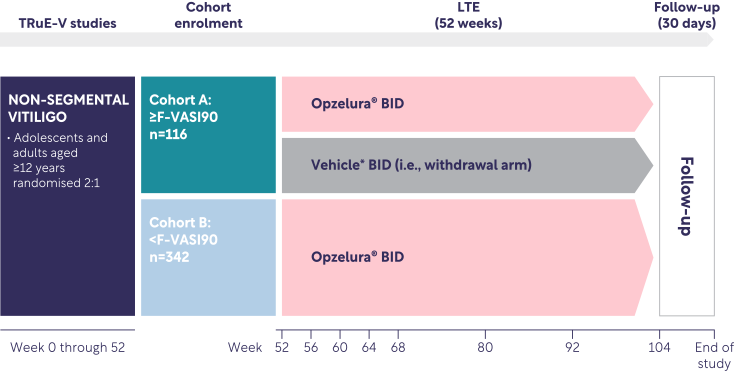
Adapted from Harris JE, et al. 2023.2


Intended for licensed healthcare professionals located in the United Kingdom and Republic of Ireland only

Opzelura® is indicated for the treatment of non-segmental vitiligo with
facial involvement in adults and adolescents from 12 years of age.1

TRuE-V was a Phase 3 long-term extension (LTE) roll-over study from TRuE-V1 & TRuE-V2 which evaluated the long-term efficacy & safety of Opzelura® (ruxolitinib) twice daily for a further 52 weeks. This double-blind, vehicle-controlled, randomised, withdrawal and treatment-extension study enrolled 458 eligible patients with vitiligo who had completed either of the parent studies (TRuE-V1 and TRuE-V2; Week 52); patients were assigned to either cohort A or B with a follow-up of 104 weeks.1–3
Adapted from Harris JE, et al. 2023.2
Scroll right if necessary

In TRuE-V1 and TRuE-V2, Opzelura® cream was statistically superior to vehicle at Week 24 across the primary (29.8% [66/211] vs 7.4% [8/109]; P<0.001) and all key secondary endpoints, with continued improvement in outcomes through Week 52.4
The TRuE-V LTE study assessed the time to relapse (defined as achieving <F-VASI75) in adolescents and adults with non-segmental vitiligo who had achieved near-complete facial repigmentation (F-VASI90) during the TRuE-V parent studies and were subsequently randomised to vehicle (Opzelura® withdrawal; Cohort A).2 The study also evaluated for how long patients maintained F-VASI90 responses when treated with vehicle or Opzelura® (Cohort B).3
| Vehicle cream (n=58)† | Opzelura® (n=58)† | |
| Age, median (IQR), y | 40.0 (32.0–47.0) | 44.0 (35.0–55.0) |
| Female, n (%) | 31 (53.4) | 33 (56.9) |
| White, n (%) | 42 (72.4) | 48 (82.8) |
| Fitzpatrick skin type, n (%) | ||
| I–III | 33 (56.9) | 39 (67.2) |
| IV–VI | 25 (43.1) | 19 (32.8) |
| Baseline F-VASI, mean±SD | 0.87 (0.49) | 0.99 (0.64) |
| Baseline T-VASI, mean±SD | 6.13 (2.10) | 6.30 (2.02) |
| F-BSA,‡ mean±SD | 0.92 (0.49) | 1.09 (0.74) |
| T-BSA, mean±SD | 6.84 (2.18) | 6.86 (1.91) |
| Duration of disease, median (IQR), y | 11.6 (3.2–19.3) | 9.7 (4.3–17.4) |
| Received diagnosis in childhood, n (%) | 16 (27.6) | 15 (25.9) |
| Disease stability,§ n (%) | ||
| Stable | 42 (72.4) | 40 (69.0) |
| Progressive | 16 (27.6) | 18 (31.0) |
| Other autoimmune disorders, n (%) | 12 (20.7) | 10 (17.2) |
| Previous therapy,¶ n (%) | 43 (74.1) | 40 (69.0) |
| Topical calcineurin inhibitor | 26 (44.8) | 22 (37.9) |
| Topical corticosteroid | 21 (36.2) | 17 (29.3) |
| Phototherapy** | 24 (41.4) | 20 (34.5) |
Adapted from Harris JE, et al. 2023.2
Scroll right if necessary
| Opzelura® From Day 1 (n=224) | Vehicle to Opzelura® (n=118) | |
| Age, median (IQR), y | 39.0 (26.0–51.0) | 39.0 (30.0–49.0) |
| Female, n (%) | 129 (57.6) | 61 (51.7) |
| White, n (%) | 180 (80.4) | 107 (90.7) |
| Fitzpatrick skin type, n (%) | ||
| I–III | 163 (72.8) | 97 (82.2) |
| IV–VI | 61 (27.2) | 21 (17.8) |
| Baseline F-VASI, mean±SD | 0.91 (0.55) | 0.88 (0.54) |
| Baseline T-VASI, mean±SD | 6.73 (2.02) | 6.70 (2.15) |
| F-BSA,‡ mean±SD | 1.02 (0.64) | 1.01 (0.63) |
| T-BSA, mean±SD | 7.50 (2.00) | 7.42 (2.06) |
| Duration of disease, median (IQR), y | 11.7 (5.2–21.7) | 13.6 (6.8–23.4) |
| Received diagnosis in childhood, n (%) | 86 (38.4) | 43 (36.4) |
| Disease stability,§ n (%) | ||
| Stable | 167 (74.6) | 91 (77.1) |
| Progressive | 57 (25.4) | 27 (22.9) |
| Other autoimmune disorders, n (%) | 42 (18.8) | 26 (22.0) |
| Previous therapy,¶ n (%) | 138 (61.6) | 69 (58.5) |
| Topical calcineurin inhibitor | 79 (35.3) | 38 (32.2) |
| Topical corticosteroid | 72 (32.1) | 24 (20.3) |
| Phototherapy** | 70 (31.3) | 37 (31.4) |
Adapted from Rosmarin D, et al. 2023.3
Scroll right if necessary
Opzelura® is contraindicated during pregnancy and breastfeeding.1
*Patients randomised to vehicle who relapsed (i.e., <F-VASI75) could apply Opzelura® BID rescue treatment for the remainder of the LTE period.2
†One patient from the vehicle arm and 2 patients from the Opzelura® arm were incorrectly assigned to this cohort and were not included in the efficacy analyses. Two other patients (1 in each arm) were also excluded from the efficacy analyses.2
‡Percentage of T-BSA.2,3
§Determination of disease stability was based on investigator judgment.2,3
¶Patients could have used multiple previous lines of therapy.2,3
**Phototherapy includes NB-UVB phototherapy, excimer laser, PUVA photochemotherapy, and other phototherapy.2,3
BID, twice daily; BSA, body surface area; F-BSA, facial body surface area; F-VASI, Facial Vitiligo Area Scoring Index; F-VASI75, ≥75% reduction from baseline in Facial Vitiligo Area Scoring Index; F-VASI90, ≥90% reduction from baseline in Facial Vitiligo Area Scoring Index; IQR, interquartile range; LTE; long-term extension; NB-UVB, narrow-band ultraviolet-B; PUVA, psoralen ultraviolet-A; SD, standard deviation; T-BSA, total body surface area; TRuE-V, topical ruxolitinib evaluation in vitiligo study; T-VASI, Total Vitiligo Area Scoring Index.
UNITED KINGDOM
Adverse events should be reported.
Reporting forms and information can be found at:
www.mhra.gov.uk/yellowcard or search for MHRA Yellow Card in the Google Play or Apple App Store.
Adverse events should also be reported to Incyte by calling 00-800-0002-7423.
REPUBLIC OF IRELAND
Adverse events should be reported.
Reporting forms and information can be found at HPRA Pharmacovigilance:
www.hpra.ie. Adverse events should also be reported to Incyte by calling
1800‑456‑748.
This is a promotional website intended for licensed healthcare
professionals in the United Kingdom or Republic of Ireland.
You are now leaving the Incyte OPZELURA® website. This link will take you to a site that is not owned or maintained by Incyte. Incyte is not responsible for the information contained on third–party sites. Would you like to continue?
You are leaving the site https://www.opzelura.co.uk/. This link will take you to the site https://www.incyte.com, owned by Incyte Corporation and managed by the company.